Saturday, October 15, 2005

 PDF
PDF


Friday, October 14, 2005
Feminist Economics 101: The first half of Marilyn Waring's Counting for Nothing

Alright, so as you may notice i have not posted for a couple of days – partly out of mid-week fatigue and partly because i am finding it difficult to figure out exactly what to say about Marilyn Waring’s book Counting For Nothing, which i am now half-way through.
But first, before getting to that, a few technical notes, after two weeks blogging:
- i am wondering if i made a mistake going with blogger rather than wordpress – seems a bunch of features i would appreciate (i.e. categories) require work-arounds which are a pain in the ass…
- finally think i figured out the “post template” function, only it’s not as nifty as i had hoped. It basically just starts your posts out with some html code, you then have to fiddle with it
- i have added a “read more” function to my template, so that those loooooong posts don’t completely clog up my main page.
OK, now on to Waring’s book…
As i mentioned in my post earlier this week, after having read the Introduction to the Second Edition, this book argues that there is a male bias in the way that countries calculate their National Accounts.
Seeing as i am only half-way through this book, what follows is in-a-nutshell how i see the core of Waring’s argument so far:
- Countries figure out their “important numbers” (i.e. GDP, GNP, Consumer Price Index, unemployment rate, etc.) from a bunch of different surveys and censuses, and together these are called “national accounts” – these numbers are used by industry and government to set policy goals, pass legislation, work out their economic programmes, etc.
- There are a number of “grey areas” built into the very concepts used in these accounts, the most noteworthy one being the so-called “productive boundary”, that dividing line between activities which count as work and those that do not. To deal with these grey areas, monetary values are imputed to various activities even though in practice they are either unpaid or paid in kind.
- Under the present world economic system, these grey areas – which in and of themselves may be unavoidable and need not be instruments of oppression – are manipulated in such a way so as to grossly undervalue or even completely devalue women’s work. Thus, values are imputed to some productive activities but not others – and the ones that get counted tend to be activities done by men, while the ones that get relegated outside of the productive boundary tend to be done by women.
- This manipulation of the national accounts, this hiding of women’s labour, is part of a conscious strategy by male accountants, statisticians and politicians to exploit women.
- This process occurs in different ways, but is essentially the same in both the developed countries and the Third World.
- If this situation were remedied “the repercussions would be felt in various fields of social policy: certain forms of social security would be extended to them [housewives], as would access to adult vocational training pogrammes presently restricted to the ‘working’ population, and a greater investment would be made in social facilities such as child care centres.” (p. 10)
- Nevertheless, the question remains: “To what method level would this method be effective, and at what point would patriarchy reassert its power?”
OK, on points 1 to 3 Waring makes her case very well. She gives example after example of men’s unpaid labour being given a monetary value in the national accounts, and example after example of women’s work being denied any monetary value. This is even in the case of work that is often paid – her wonderful example being “when a man marries his housekeeper the GNP goes down.” (p. 61)
Now, i must admit that i am less convinced about Waring’s other points.
Point Number 4: Is there a conscious conspiracy involving a brotherhood of crooked accountants?
Sylvia Federici, in her book Caliban and the Witch: Women, the Body and Primitive Accumulation, describes how in the early days of the capitalist system women were pushed out of the paid labour-force by a cross-class alliance of male workers and male rulers – now that was a conscious strategy… and it gave rise to an economic system – capitalism – which is thus congenitally and inherently patriarchal. As Maria Mies wrote in her book Patriarchy and Accumulation on a World Scale: “Patriarchy thus constitutes the mostly invisible underground of the visible capitalist system.” (p. 38)
So again: are crooked accountants a feature of this system?
The question is difficult to answer, because it really depends on what one means by “crooked”. In terms of not being fair, of being exploitative, of stealing the wealth that people create, of encouraging parasitism… capitalism itself is “crooked”. But once that is said, it has to be added that within a capitalist system, an accountant or a statistician or a politician does not have to be at all crooked or dishonest in order to replicate the dishonesty and immorality inherent in the system itself.
There is a tendency to want to describe various problems as being due to “corruption” and “dishonesty”, and a great reticence to see them as structural aspects of a system. This is not only because structural problems may seem more daunting, but also because by personalizing an issue it becomes more interesting, it excites people’s imagination more, and in that way it is much more accessible. Waring – herself a former politician – may just be adept at playing to the crowd, or she may herself believe that she is up against a conspiracy by a cabal of highly-placed United Nations officials, but in the end this kind of personalistic explanation promises more than it can deliver.
The oppression of women, and the fact that so much of women’s labour is rendered invisible, are structural features of the capitalist system. Waring may identify many sexists within government, but no matter how many she exposes, it’s a safe bet there’ll still be many many more left for her to uncover, because their “sexism” – like the accountants’ “crookedness” – are features of the system. So in order to remedy this situation, a structural and historical analysis is necessary. Waring comes up short here – she is long on describing effects of capitalism but overly simplistic when describing causes.
I would recommend interested people read Maria Mies’ Patriarchy and Accumulation on a World Scale, Sylvia Federici’s Caliban and the Witch: Women, The Body and Primitive Accumulation and Butch Lee’s Night-Vision: Illuminating War and Class on the Neo-Colonial Terrain, The Military Strategy of Women and Children on these questions.
Point number 5: In fairness, i believe Waring is going to try and back up this point more in the second half of her book, i will hold off on commenting on what i suspect her argument will be. Suffice it to say, that i am highly suspicious…
Point number 6 is pretty much obviated by point number 7. Essentially, Waring sees great changes potentially coming from a less sexist system of national accounts, but concedes the possibility that “patriarchy reassert its control.”
Whether or not this would be the case is indeed a good question, and one that all manner of left-feminists have mused over for some time now. How sexist does capitalism have to be, how great are the possibilities for a “post-patriarchal capitalism”?
There seems to be an implicit message in this book that the world economic system can become post-patriarchal without there necessarily having to be an anti-capitalist revolution. Waring seems somewhat taken by the belief in “male values” and “female values”, so i am guessing she imagines a world economy shorn of its male bias being one which would also be re-oriented towards human needs, less harmful of the environment, more egalitarian. At no point does she call for anything like socialism or communism or anarchism, and one gets the impression that she believes that women’s empowerment will simply cause some wider consequences that need not necessarily be spelled out…
…one almost has the impression of looking at a mirror image of the left-wing cliché that once capitalism is abolished other questions will sort themselves out. According to some comrades, no special programme is needed to deal with women’s oppression, because that’s already covered when we say “smash capitalism”!
I would argue a radically different, and more pessimistic, position that either Waring’s feminism or the clichéd left-wing anti-capitalism. Work by women like Maria Mies, Butch Lee and Sylvia Federici has convinced me that any struggle for human liberation “will have to transcend or overcome capitalist-patriarchy as one intrinsically connected system” (Mies, p. 38) and this means explicitly analyzing and fighting against all manifestations whether we see them as being primarily “capitalist” or “patriarchal”.
In this light, Waring’s plan to reform how the United Nations keeps its accounts seems somewhat trite and pedestrian - and i think this is part of why i have found it difficult to write about this book. While i find much of what Warin has to say to be interesting, i have repeatedly found myself muttering “who gives a fuck what the United Nations thinks!” – i mean this is not a system most of us conceive of being a part of any kind of liberated future, the national accounts would fade into history in a world of “no borders no nations”, never mind no classes, so what is a radical anti-capitalist supposed to be learning from this?
These questions have been popping into my head over the past few days as i have read Waring describe her run-ins and discussions with this government statistician and that economic advisor. I do have an answer in mind, but its still cohering on the edges of my mind, and i have only read half of the book so far, so i’m going to keep it under my hat for now…
Hopefully by this time next week i’ll have finished this book, and then i’ll let you know what i think!
Categories: book-review, capitalism, sexism
Tuesday, October 11, 2005
Hope Breathing Life, Postcards for Liberation, by Zolo Agona Azania

Please Forward Widely
Kersplebedeb Distribution is pleased to announce the publication of Hope Breathing Life: Postcards for Liberation by Zolo Agona Azania.
Hope Breathing Life is a collection of postcards representing the art of Zolo Agona Azania. Zolo is not only a remarkable artist but also a political prisoner, the victim of a racist frame-up, who has spent a quarter century behind bars, most of it on death row.
Owusu Yaki Yakubu, in his piece "Who Is Zolo Agona Azania?" (pubished as an introduction to Zolo's pamphlet Money and Power: Hook or Crook) provides this useful summary of how Zolo ended up where he is today:
Read more...
"Zolo Azania is one of the numerous African-Americans who await execution as a result of a racist criminal justice system. Moreover he is a politically conscious activist, who at the time of his arrest and capture in 1981, was actively involved in the movement for the self-determination of African-American people. The fact that he defined himself as a New Afrikan and was committed to the liberation and independence of Black people within the borders of the U.S., directly influenced the way the police, the prosecution, and the Indiana courts denied him a fair trial and fanned the flames of prejudice to obtain the death penalty.
"Zolo was sentenced to death after his conviction for a 1981 bank robbery and the killing of a Gary Indiana police officer who was fatally wounded in an exchange of gun fire with three men who fled from the bank. Zolo was not arrested at the bank, but miles away walking unarmed down the street. The prosecution intimidated witnesses, suppressed favorable evidence, presented false eye-witness and expert testimony, and denied him the right to speak or present motions in his own behalf.
"The two other men charged and convicted with Zolo received sentences of 60 years, but because of Zolo’s political history and beliefs, and in order to permanently silence his militant voice for liberation, the State ignored the rules of evidence and fair trial to obtain the death penalty from an all-white jury. The State suppressed a gunshot residue report showing no residue on Zolo’s hands as well as other favorable scientific evidence, suborned perjury by telling a critical witness who was unable to make an identification to identify Zolo, and falsely and sensationally accused him of firing the fatal bullet,
“execution-style.” The trial, which was moved from Lake County (Gary, Indiana), which has a substantial Black population, to Allen County (Fort Wayne) with a small Black populace, was tried amid media and law enforcement hysteria. Armed police surrounded the courthouse, and uniformed police ringed the walls and front gallery inside of the courtroom."
Twenty-five years after his wrongful conviction, two-sentencing trials and numerous appeals later, Zolo is awaiting a third death sentencing trial. Throughout his ordeal, Zolo has maintained a strong spirit of hope and a commitment to justice for all.
As he continues to struggle for his life in Indiana, Zolo also reaches out to us with his words and his art. From his tribute to the struggle of Emmett Tilll’s family to his depiction of the story of Mumia Abu-Jamal, the paintings collected in this book are a testament of his spirit. It has been several years since Zolo has been able to paint on a canvas. At the institution where he is currently being held, the only art supplies allowed are colored pencils. He also works with other media; he draws and makes collages from pictures and words clipped from magazines, newspapers, and pamphlets. His illustrations have been used in radical newspapers such as Social Change and Development and Burning Spear, as well as in small press publications of his writings.
As Zolo prepares for his death sentencing trial, he continues to draw attention to the plight of all death row prisoners in Indiana. Zolo writes: “Another legal murder was premeditatedly planned and carried out at midnight, July 27, 2005. i hate these things. i am determined to fight harder. Losing has never been an option to me. What has happened to me can easily happen to any poor person.”
With the publication of “Hope Breathing Life”, we hope to share with you the vibrant spirit of Zolo’s art. This is the first time this art has been collected and reproduced in full color. The collection spans over twenty years, displaying artistic skills learned in prison and genuine talent.A recent ruling in Zolo’s case stopped the state from continuing to seek the death penalty. The prosecutor is appealing, and early in 2006 the case will be heard before the Indiana Supreme Court. Funds from the sale of this booklet will be used in Zolo’s ongoing support campaign.
To see scans of Zolo’s postcards online, or to place an order via PayPal, please go to Hope Breathing Life: Postcards for Liberation
For wholesale and review orders, please contact Kersplebedeb at info@kersplebedeb.com
For more information about Zolo and his case, please go to:
Zolo Agona Azania Page
and http://www.zoloazania.org/
and http://www.thezoloazaniaproject.com/
Categories: book-review, prison, publishing, racism
Monday, October 10, 2005
New Orleans police caught attacking suspect
New Orleans police caught attacking suspect
CTV.ca News Staff
In the most recent set of grisly images to come out of a still-reeling New Orleans, several police officers appear to beat an elderly man, then rough up a member of the news crew that caught the incident on tape.
The Associated Press Television News crew recorded the event on Saturday in the French Quarter, a historic neighborhood damaged by Hurricane Katrina, but that escaped the catastrophic flooding.
The incident occurred outside a bar near Bourbon Street, the famous raunchy strip.
The suspect, identified by police as 64-year-old Robert Davis, appeared to resist arrest by the officers. In the tape, he can be seen twisting and flailing as he was dragged to the ground by four officers. One of the officers then kneed Davis and punched him twice.
One member of the news crew was also physically and verbally assaulted after approaching one of the officers involved in the dispute.
"I've been here for six weeks trying to keep my (expletive) self alive and you (expletives) want to come and (expletive) up my city. Go home," an officer, who identified himself as S.M. Smith, told him.
Davis was charged with public intoxication, resisting arrest, battery on a police officer and public intimidation.
The three officers involved in the dispute will be the subjects of an immediate criminal investigation, said Capt. Marlon Defillo, chief spokesman for the New Orleans Police Department, on Sunday. He called the incident "troubling."
"There will be a criminal investigation by the police department where we will take immediate action today," he said. "Mainly, those three police officers that we've identified will be suspended from the department today and they will be arrested. And they will be arrested for simple battery."
When police investigate accusations of police brutality, their first question is often whether or not the degree of force used by police was appropriate for the situation. In this case, it clearly was not, said Defillo.
"It was not in line with the department's policies and procedures. It was not in line with the department's training. So certainly, that's a great concern for the police department."
Defillo didn't attempt to excuse the behaviour of the officers, but said the incident does come at a time when many officers are stressed out and tired.
"Our police officers are working under some very trying times," Defillo said. "So it's a difficult time, but it doesn't excuse what our jobs are supposed to be."
The incident comes as the New Orleans police continue to deal with the aftermath of Hurricane Katrina, which flooded the city and reduced it to a state of lawlessness for
weeks, and the resignation last month of Police Superintendent Eddie Compass.
Officers have slept in their cars and worked around the clock at times in the hurricane's aftermath. Many have lost their homes and been separated from their families.
Categories: disasters, police, racism
Sunday, October 09, 2005
Saturday, October 08, 2005
Rape and Murder in the News

A couple of newspaper articles in the Montreal Gazette caught my attention yesterday.
First off was the statement by police that there is a serial rapist attacking women on the North Shore of Montreal. Between March 2004 and June 2005 at least eight women were attacked after getting off a bus or walking in the street at night in Laval, St-Jerome and Terrebonne.
The rapist is supposed to be medium build, about 5 feet 10 inches tall with short brown hair. He was often seen wearing a baseball cap, is francophone, and a red Honda Civic hatchback was spotted near six of the attacks. All of the attacks happened on Wednesday and Thursday nights between 10pm and 1am, and women were threatened with a weapon in all but one of them. We are told that now that this has been made public, the rapist may change his pattern…
Police did not issue any warning to women before yesterday, October 7th 2005, according to the Gazette article:
Asked why police didn’t make the information known earlier, Constable Francois Dore of the Surete du Quebec – the force co-ordinating the investigation – said police had several details to investigate first.
Also, because the assaults took place in different towns, and were being investigated by different forces, it wasn’t until this spring that police realized the cases might be connected, he said.
[….]
Laval police spokesperson Sgt. Daniel Guerin said making details public too early can compromise a police investigation.
In the present case, Laval police placed undercover offices at bus stops as part of their investigation, he said.
What’s more, now that several details have been made public, the offender is likely to alter his patterns, Guerin said.
It is worth perhaps also noting the chronology of these attacks:
May 11, 2004 – Laval
June 16, 2004 – St-Jerome
June 24, 2004 – St-Jerome
July 1, 2004 – Laval
Nov. 4, 2004 – Laval
March 24, 2005 – Terrebonne
April 8, 2005 – Laval
June 30, 2005 – St-Jerome
So according to the police, it took until “spring 2005” for them to realize there was a serial rapist – this despite two attacks occurring within ten days of each other in St-Jerome in summer 2004, and three different attacks occurring in Laval.
Deconstruct especially what Sgt. Guerin is saying: making details available would have hurt the investigation, which involved putting undercover cops on buses.
Putting decoys on buses sounds like a great idea, but think a moment: how would warning women in any way interfere with this? Well, he says it: warn women and “the offender is likely to alter his patterns” – don’t warn women, and the rapist will keep to his pattern!
Don’t warn women, and women won’t take any special precautions to protect themselves, so he’ll keep on raping them on Wednesday and Thursday nights, and hopefully eventually he’ll stumble upon a decoy and the police can say they saved the day!
Let me now skip to another newspaper article, also in yesterday’s Gazette, dealing with the report issued on October 6th by Judge David Plosz, an Alberta Fatality Inquiry Judge, about the September 28th 2003 murders of a woman and her son at the hands of her husband:
Blagica Fekete told RCMP on at least seven different occasions that her husband had threatened to kill her and that he had three guns at his home. A close friend of Blagica's submitted a 10-page statement to police detailing Josif's history of harassment and abuse.
Most disturbing of all was a statement Blagica Fekete gave Sept. 24, 2003, when she told police her husband had escalated the threats to include himself and their son. Little Alex told her, "Mommy, ah, Daddy said you gonna be dead soon. Me and him."
What did the police do? Well, they did investigate the husband’s complaint that Blagica allowed her son to ride in a taxi-cab without a car seat… but about the little matter of his threatening to commit double-homicide, well that would have been a bit too much trouble to deal with…
A worker at the Central Alberta Women's Shelter, where Blagica stayed at one point, warned police and Alberta Children's Services two days before the Sunday shootings that the mother and son were in danger. But police didn't act, and a social worker who wanted to seek an emergency protection order was advised it would have to wait till Monday.
In both the case of the North Shore serial rapist, and the murder of Blagica and Alex Fekete, the first thing you notice is that the police failed to effectively stop male violence. This is no news – i mean since the 1989 Montreal Massacre the police have failed to prevent the murders of 604 women and 173 children in Quebec, victims of male violence (a list maintained of all of these victims in maintained by the Collectif Masculin Contre le Sexisme) – and the response is to issue more recommendations and just hope that the police do a better job in future. “Better luck next time, boys!”
But the enduring inability of the police to actually ever get it right leaves a void that must be filled. Regardless of whether you are anti-cop or not, an anarchist or a liberal, you have to admit that the police are just not able to deal with this problem, and unless you think rape and murder of women aren’t problems that need dealing with…
Avoiding completely the question of whether we even want police in our communities, there is an obvious need to develop our own capacities for collective self-defense. Call it “safety” or all it “armed struggle” or call it a “feminist guerilla”, there is a particular need for women to develop their capacities, because – sad to say – even a left-wing or anarchist group led by us guys will most likely be unable to effectively appraise and intervene in cases of male violence against women. I mean, we’re still stumbling over how to deal with cases where anarchist or left-wing men have abused women and we know their names and addresses!
It is worth noting what Amazon theorist Butch Lee has written regarding the “Green River Killer”, a god-fearing Christian who raped and killed at least 48 women (many of them teenagers) over a twenty year period:
Women could have stopped it. But not by staying embedded in men’s laws for women. […] Armed units of women could have surrounded & patrolled Sea-Tac where the Green River Killer got women. Women’s armed checkpoints could have kept track of i.d.s and peoples’ comings & goings. Girl-children could have been taken to women’s schools, where they could have been taught survival sense. Rapists could have been hunted down by teams of women and killed. But all that would be illegal, while being defenseless & isolated are 100% legal and desirable under men’s laws for women. We’ve all had fantasies of girl gangs, of women with guns patrolling streets and making free territory for women, of women running it. “In dreams begin responsibilities.”
(from After Anti-War Movements win or Lose in Iraq… ther’s still women)
Is this realistic? Certainly not now, not in this situation where (to again quote Lee) “women have no army of our own, no foreign policy that is ours, no rescue force, no territory, no home base. No home.”
Acknowledging the fact that we’re starting from scratch is a start, especially if we also have an idea of what we want to build. Denying that there’s a problem, denying that there’s a need to be filled – that’s just going to make it all worst. And it’s not like we have to go from just reading about this stuff in the Gazette to having a Women’s Army in one quick step.
To give an example: about ten years ago there was a wave of violence against women in the student area known as the “McGill Ghetto”. Lots of women were being harassed and attacked day and night, and several had been raped. The police, the media, the university, etc. – all of those public authorities – were really uninterested in doing anything. One woman was apparently even attacked while, just streets away, others were marching to “take back the night” – but still this was not a “real issue”.
So a bunch of women wrote up posters with the big title “Attention Women!” explaining that the area was not safe and that attacks had been taking place, got together with a bunch of people they knew both male and female and plastered the area with them. Didn’t require an underground cell or an armed capacity, just doing what was do-able.
And wouldn’t you know it: within a day there were articles in the newspaper, women at shelters were being interviewed, and suddenly Montreal had itself a “real issue”.
Did this solve “violence against women”? Of course not. But it pushed things from a situation where nobody was talking about it to one where people were doing so. Little steps, but far better than nothing.
Unfortunately, this is something i imagine we’ll be coming back to…
UPDATE: Please note that on Wednesday, January 25th Benoit Guay – a Montreal police officer – was arrested – he stands accused of being the North Shore rapist – read more here.
Categories: montreal, police, violence-against-women
Friday, October 07, 2005
In the Interim: A Photo
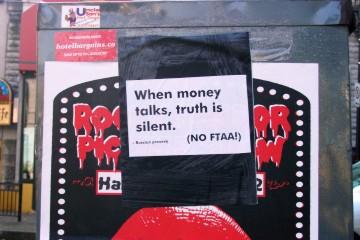
I started into the first chapter of Waring’s book yesterday, and feel that i may have not given her enough credit after having read her Introduction to the Second Edition in what i commented on about that yesterday.
Within the first chapter she does go further than in the Introduction in identifying the system as something somewhat more than simply saying that we are dealing with a case of accounting fraud here, and does acknowledge that an approach of merely tidying up the ledgers to include women’s work and the environment would have its limitations, asking “To what level would this method be effective, an at what point would patriarchy reassert its power?” (p. 10)
This is a question i imagine will be coming back to, but want to actually read more before saying more, so for the time being i am merely posting the following photo, taken in downtown Montreal a couple of years ago, which i believe nicely sums up where i see Waring’s argument going.
Categories: capitalism, photo
Thursday, October 06, 2005
Reading the Introduction to the Second Edition of Marilyn Waring's Counting for Nothing
Now I must say, it is a joy to be well rested - this morning I gave into temptation and stole a couple of extra hours sleep, and what a difference that makes!
I have just re-read my first blog entries, in part inspired by the nice ego stroke from Hammy Goonan (who has also linked to me from his own blog Goonanism), and I cannot believe how many typos I have made. Note to self: use the fucking spellcheck!
Last night i started to read Marilyn Waring’s Counting for Nothing: What Men Value and What Women Are Worth. A few words on Waring, from Wikipedia, the free encyclopedia:
In 1975 general election, she became the New Zealand National Party member of Parliament for the Raglan electorate. She fell out with Prime Minister Rob Muldoon almost immediately.
During her period in Parliament, she served as Chair of the Public Expenditures Committee, Senior Government Member of the Foreign Affairs Committee, and on the Disarmament and Arms Control Committee.
Waring made history during her political career when she withdrew her support from her party over the issue of a nuclear-free New Zealand, precipitating a snap election in 1984. Her action brought down the government, and led to New Zealand becoming the first country to ban nuclear ships from its harbours.
So Waring was the the woman who brought down the government, but in 1984 she left politics and became an academic, developing a critique of economics from a feminist and ecological perspective. That work led to this book.
Having many personal connections to Aotearoa, i remembered who Waring was and the dramatic results of her actions in ’84, so she’s of interest already. But more importantly, a “feminist critique of economics” is something that strikes me as having much interest – and i look forward to seeing what Waring has to say.
Now last night i only got through her lengthy “Introduction to the Second Edition” (hereafter ISE), and i had mixed feelings – though overall i was pleased.
Waring’s basic argument – as i understand it before having read the book – is that unpaid labour and informal work around the world are at least as important to the economy as waged labour, and that the reason they are kept “off the books” is in order to make it look like men (who are over-represented in the formal sector) do more work than women (who are over-represneted in the informal sector).
I imagine Waring’s argument might bhe similar to that put forward by Maria Mies in her groundbreaking book Patriarchy and Accumulation on a World Scale:
“the law of exchange of equivalents must not be applied when it comes to women’s work. Therefore, this work is separated out of the (capitalist) economy and obscured. Women do not stop working in the houses, in the fields, in the factories, they do not stop giving birth to children and bringing them up but this work is no longer considered socially productive work, it is made invisible.” (p. 160)
This argument has been made by other women too, especially those around the International Wages for Housework Campaign, and by now the novelty has worn off: it’s true, it’s obvious… it’s nothing new.
So what i liked about the ISE is that here Waring takes this argument to the next level, which i would argue is necessary if it is to retain its radical potential. Waring notes here that in the twelve years between Counting for Nothing being written and the second edition coming out, there has been a strong move to recognize and impute (which means give monetary value to) women’s domestic labour. Similarly, monetary value has been imputed to environmental “assets”, so that things like “carbon trading” and “environmental accounting” are now being championed by government economists, as ways of integrating the value of natural resources into economic figures and projections.
So, seemingly spurred in part by criticism from progressives, bodies like the United Nations and the International Labor Organization might seem to have heeded feminist and ecological arguments. Yet as Waring points out, without changing the actual basis of the economic system, such a “victory” is really anything but – as she writes of her own calls to integrate nature and women into national accuonts, “My short-term policy needs for visibility were at odds with my passionate desire to bring this system to its knees.” (pp. xx-xxi)
The problem with integrating women’s labour and the environment into standard economic models should be obvious, for we are not dealing with a sensible or just system which merely needs some technical improvements. Nor – and here i am not sure whether Waring realizes this – are we dealing with a case of fraudulent accountants “fixing” the books in order to deny women a wage. The system, finally, cannot simply be criticized for “creating inequality”, although this is one half of the story. To truly grasp what we are up against, it must be stressed that capitalism is fuelled by inequality – if everyone was equal, or even if everyone in the world had their basic needs met, then the entire economy would lose its dynamic pulse.
When national accounts are corrected, and women’s labour and environmental assets are included, what we get is the spread of capitalist values to new areas, legitimizing what has happened before in new ways. For instance, let’s say a cruise missile costs $1 million, and an old-gowth forest is imputed to be worth a billion dollars – according to market mechanisms, a country which logs the entire forest and sells the timber in order to buy 1000 cruise missiles neither loses nor gains a thing!
Or for an actual, and actually sickening, account of how economics merely legitimizes the brutality of capitalist relations without actually mitigating them in the least, consider the approach the World Bank has taken to HIV/AIDS in the Third World. The following is from Nana K. Poku’s essay “Confronting AIDS With Debt: Africa’s Silent Crisis”, in the book The Political Economy of AIDS in Africa:
Consider this cruel irony: the World Bank – as a sponsor of UN/AIDS – is charged with funding strategies to alleviate poverty and to reduce HIV infectivity in the developing world. Yet it could write concerning the pandemic that ‘if the only effect of the AIDS pandemic were to reduce the population growth rate [in developing countries], it would increase the growth rate of per capita income in any plausible economic model’. Moreover, the Bank has developed the idea of ‘disability-adjusted life year’, or DALY, to measure the number of years lost to illness and death. ‘By this calculation,’ reported the Washington Post, ‘a country that spent US$1,000 a year to save the life of someone earning US$500 a year would suffer a net economic loss.’
Here is capitalism in all its uglyness, there for all to see, not hiding behind anything all – and yet one fails to see how imputing monetary values to work in the informal or subsistence sectors could do more than increase the worthiness of some lives, and perhaps decrease the worthiness of others – either way, the cold calculus of dividing between those worthy of life and those worthy of death would continue, only in a more “rational” guise.
Or how about this example, which Waring gives on pages xlv and xlvi: in 1998 there was a clash at the World Bank regarding a $2.6 billion, 1,600-kilometer pipeline from Chad through the Camerooon to the Gulf of Guinea. The economists were pointing out that the pipeline would double the size of Chad’s economy within ten years, whereas the environmentalists were pointing out that not only would it endanger the survival of the black rhino in the Deng Deng forest, and seriously disrupt the lives of pygmy tribes in Cameroon. As Waring points out, “there is simply no way to commodify the lifestyles of pygmy tribes, or the endagered black rhino.” (to which i can already hear a thousand suits saying “oh yeah, just watch us!”)
What Waring suggests instead of merely adding women’s economic worth to pre-existing models is a more thorough overhaul of these models, “triangulating” the data with non-monetary assessments of environmental worth and data from time-use studies. She states that this would give an accurate accounting of how productively people spend their time and whether national economies were actually producing or depleting resources:
“In this transparent picture of reality, the range of knowledge and expertise across disciplines can be brought to the policy process. Economics no longer has us by the throat. Politicians will be required to exercise transparent judgements and find no simplistic and cowardly retreat behind growth-rate indices.” (p. xlviii)
Here i suspect Waring is going off the rails, and this is probably related to the fact that she has not yet used the word “capitalism” or “exploitation” once, for she still seems invested in the idea that someone has been playing with the books, and all “we the people” have to do is fix these books and shout “Aha! We got you!” and the guilty parties will be shamed into doing us right.
She has not digested – perhaps has not even swallowed – the uncomfortable fact that this is the same system which condemns between 13 and 18 million people to die every year as a result of starvation, the same system that spawns military conflicts around the globe, the same system which (as we have seen) believes the calculator is the best tool to use when deciding who gets anti-AIDS drugs in the Third World, the same system which grew out of the Witch-Hunt, the kidnapping of Africans, the genocide of indigenous peoples around the world… and this is the system that can be “brought to its knees” once politicians stop acting “cowardly” and the real economic realities are made known to all?!?!?!
I prefer Butch Lee’s observation that:
“Every inch of this country and every body & blade of grass in it is owned by patriarchal imperialism, a killer culture which will butcher you, me, our kids, too & 10,000 other women the day they think it necessary.” (The Military Strategy of Women and Children, p.74)
Or as Maria Mies pointed out in her groundbreaking book Patriarchy and Accumulation on a World Scale:
“All these efforts to ‘add’ the ‘woman question’ to existing social theories or paradigms fail to grasp the true historical thrust of the new feminist rebellion, namely its radical attack on patriarchy or patriarchal civilization as a system, of which capitalism constitutes the most recent and most universal manifestation.” (p. 13, emphasis in original)
********
So, having only read the introducition, i am getting ready for a liberal book with radical insights. You can do a lot worst in life, i know, and i didn’t expect a whole lot better. The whiting out of women’s work is a very important question, and it does help explain some of the major sexist weaknesses of the traditional left, so i imagine much of what Waring wil be discussing will be relevant and of interest – it’ll just reqire a bit of anti-capitalist contextualization. Nothing unusual about that…
Categories: book-review, capitalism, sexism
Wednesday, October 05, 2005
The Boundaries of Eros by Guido Ruggiero, etc.
Alright, having finished The Boundaries of Eros by Guido Ruggiero, I have a few things to say about sex in Renaissance Venice, about books that I read, and about this blog.
First off, a few observations about The Boundaries of Eros: Sex Crime and Sexuality in Renaissance Venice.
The final chapter of this book is called “Perspectives on Normal Sexuality: An Essay”, but as much as anything else it is really a conclusion to all that came before, for throughout this book Ruggiero draws conclusions about “licit sexuality” from his examination of the illicit. Besides polishing his previous observations and giving the reader a sense of closure, there’s not a whole helluvalot new here.
Well, with the exception of a particularly noteworthy quote from the court records of the Patriarchal Court of Venice in the 1470s.
It would seem that here was this fellow Nicolo whose wife wanted her marriage annulled, claiming that he was unable impotent. Nicolo’s boss Francesco Barbetta was for some reason interested in helping him out, and so he arranged for Nicolo, the local priest, a scribe, and Francesco’s father all to get together with two female prostitutes.
Nicolo not only proceeded to fuck both of these women, but at one point came in the priest’s hand, at another point had the priest feel his cock while he was having intercourse. And this is in the court records, and nobody at the time thought it scandalous, wrong, or abnormal…
All of which is, quite graphically, to say that “normal” sex in other times might not quite be what Pat Robertson or Pope Benedict XVI – or, for that matter, Dr. Phil or Oprah – think it should be today. Which isn’t to say it was necessarily any more liberated or less patriarchal than sex today – the same legal system that did not blink at this public sex was busy executing sodomites in record numbers – just to say that it was different.
The only other new observations which made an impression on me in this last chapter were (1) Ruggiero’s speculations that increasing age segregation may have been related to the general explosion of homophobia at the time, as there was often a teacher-student older-younger active-passive structure in gay male relationships at the time and (2) that affective bonds between sex partners may have been more common amongst the working class than amongst the nobles. This point in particular I found interesting, not only as it flies against certain stereotypes of “courtly love”, but also because it tends to lean against Sylvia Federici’s claim that the fifteenth century saw a dramatic rise of working class male sexual violence. I say “lean against” because it does not contradict it – just etnds to point in the other direction.
A few last points regarding The Boundaries of Eros:
- qualifying what I wrote a couple of days ago, regarding the hierarchy of different sex crimes: these are inexact categories, that line up with Ruggiero’s categories. The legal cases seem to have been prosecuted an a more ad hoc basis, the categorization here is based on Ruggiero’s thorough sifting through the legal records of the time, specifically looking at penalties handed out.
- Furthermore, regarding Fornication, it should be pointed out that especially amongst the working class and poor people fornication was a common and accepted behaviour – the cases prosecuted were cases where someone complained, often because the guy was not willing to follow through and marry the woman as he may have promised beforehand. So not only were the cases brought to trial the tip of the iceberg (as is to be assumed with all of these categories), in the case of Fornication the cases brought to trial were certainly not representative of the pre-marital sex that was common in Renaissance Venice.
- Regarding sodomy, which I dealt with at greater length a couple of days ago, Ruggiero’s last chapter brings out an additional detail which shows how the 15th century was a time of increasing persecution of gay men. It seems that anal sex between husband and wife – while always illegal – was also subject to increasing levels of punishment:
Most suggestive is the fact that the early cases [14th century] of this activity reported between husbands and wives invariably ended with acquittal. Eventually, however, as paranoia about sodomy grew, the Ten did convict and punish husbands, first with lesser penalties, but occasionally toward the end of our period [15th century] with execution. It appears that as the Ten became more concerned with what they saw as a growing subculture of sodomy, they became more willing to burn out of society what they had previously viewed in the light of contraception and thus been willing to overlook. (pp. 165-166)
Ruggiero finally mentions the word “abortion” on page 166, but just to say that it must have occurred. That’s it! It “nonetheless seems to have been used”! Nothing more to say on the subject!
This is kind of disappointing. I mean I have no idea what politics Ruggiero has – he’s a professor of history at the University of Miami, that’s all I know about him – but his silence about both abortion and lesbianism are in sad contrast to the useful observations and speculations he does make about women. I guess this book would be best described as a look a how men and women dealt with illicit male sexuality in Renaissance Venice, and perhaps this is merely a necessary result of the fact that the law codes that prosecuted sex crime then were blind to these female realities, but if this is the case at the very least Ruggiero should have said so!
That said, I did like this book, and did find it interesting. I guess on a scale of one to ten I would have to give it a 5 for politics, a 7 for information, and a 9 for readability.
All of which brings me to my next point, which is how I read books, and how I intend to write about them on this blog.
Sketchy Thoughts is going to be a less-than-formal brain dump for me. I hope to publish entries most days of every week, mainly dealing with books as I read them. Perhaps I’ll also talk about television shows or movies I’ve watched, music I’ve listened to, the state of the world or the weather, but for the immediate future I see the focus being on books.
However, what I will be writing will most likely fall short of actual book reviews – not only am I writing as I read the books but I am not holding myself to incredibly high standards. I may have misunderstood something in the book, I may be interested in an aspect which is not central to what the author is dealing with, i may have my own interpretation which may actually be dead wrong – and most importantly I may change my mind after writing what I write.
So let me reiterate: these are not book reviews – if I manage to write something coherent which works as a review, I will post it to the Book Reviews page on my website. What you see here are Sketchy Thoughts – no more, no less.
Finally, I have not been in the “educational system” since I dropped out of high school twenty years ago. I don’t get as much time to read as I would like, and I don’t often find myself reading the same things as my friends, this despite the fact that we often have relatively similar politics and interests. One part of why I am doing this blog is to have the pleasure of putting down what I am thinking about what I am reading, one part is to give myself an incentive to actually remember what I’m reading – but another part is to hopefully be able to discuss what I am reading with others.
So if you have read any of the books I deal with, and have something to say – either in agreement or disagreement with yours truly – please don’t hesitate to share.
Next book on my list… Marilyn Waring’s Counting for Nothing: What Men Value and What Women Are Worth (University of Toronto Press 1999) – a critique of economics from an ecological feminist perspective.
Categories: book-review,history, queer, sexuality, violence-against-women
Monday, October 03, 2005
Crimes Against God, Rape, and Sodomy in Renaissance Venice
OK, I managed to read another chapter of Guido Ruggiero’s The Boundaries of Eros this morning, on sodomy in Renaissance Venice (14th-15th centuries).
Once again: I am reading this and other books to try and form an opinion of Silvia Federici’s claim (in Caliban and the Witch: Women, The Body and Primitive Accumulation) that there was a dramatic increase in working class violence against women in the 14th and 15th centuries, encouraged by the ruling class as a means of diffusing class rebellion. She basesm this on the work of Jacques Rossiaud, whose book Medieval Prostitution I have yet to read.
Having now read most of Ruggiero’s book (there remains an essay on “normal sexuality”) I can’t say that he confirms or disproves Federici’s claim. What he does do is provide a very readable and interesting account of illicit sex in Renaissance Venice.
It seems that of the various sex crimes that were prosecuted at the time, a clear hierarchy of concern emerges, with the following being the order from least serious to most serious:
- rape of a woman
- adultery
- fornication
- crimes against god (sex with clergy, in a church, or between Christians and Jews)
- sodomy
These categories are unfortunately not the exact categories used by the Venetian officials at the time, they’re the categories Ruggiero uses. So for instance, rape of a noblewoman by a non-noble was actually considered very serious, as was rape of a pre-pubescent child (though less serious than consensual sodomy). Sex between Christians and Jews was more serious than sex with clergy, and in fact was one of the (rhetorical?) motivations behind legislation stigmatizing Jews. Likewise, Jewish men who had sex with Christian women were tried and convicted, but Christian men were not prosecuted for having sex with Jewish women.
Nevertheless, if the above hierarchy is misleading it nevertheless gives enough information to make some clear observations. Indeed, the exceptions only seem to prove the rule.
What we can observe is that the State was completely and utterly uninterested in women’s welfare except insofar as these women represented a form of capital for the men in their lives. Ruggiero gives some examples where individual men obviously made decisions which seem to have been motivated by love/affection/care/etc. (i.e. risking prosecution to continue an adulterous affair, even when this meant leaving one’s family and losing one’s position of power) for women in their lives, but in the eyes of the State this was besides the point.
RAPE
The penalties for rape tended to be minor. “Slap on the wrist” would be an exaggeration. Especially in the case of unmarried women, any compensation seemed to hinge on the loss of the woman’s virginity, which reduced her value for her future husband. Thus a common penalty involved providing money to be used for the woman’s dowry (to make up for her loss of marriage-value), and penalties could often be avoided altogether if the rapist and his victim agreed to marry.
Which brings up a question: why would the victim of rape agree to marry her rapist, especially as this often meant that he would get off the hook for having raped her in the first place?
Ruggiero answers this question as follows:
“For many women with limited dowry potential [i.e. poor women – me], rape, which robbed them of their virginity and tainted their sexual status in the eyes of their contemporaries, may have meant that their chances of marriage declined considerably. With great pressure to marry and limited possibilities, there may have been a certain dark logic in accepting the attacker as husband.” (p. 99)
Imagine that: as a consequence of being raped you face a life of heightened poverty, so that you end up accepting your rapist as your husband as “the lesser of two evils”. All ofb which would be encouraged and arranged by your father, brothers, and the State.
While disgusting enough, what Ruggiero exposes is different from what Federici describes. Ruggiero describes an overwhelming indifference to rape, and seems to imply that this reflects a continuity with pre-Renaissance attitudes. Regarding an increase or decrease of rape and prosecutions of rape between the 14th and 15th centuries, he finds there is mixed evidence, but too many records are missing to be draw any solid conclusions (though he does note that the fairly rare use of corporal punishment of rapists increased slightly with time). Moreover, he gives no evidence of intellectuals of the day considering rape-between-workers as a means of keeping the “lower orders” in their place – indeed, he suggests that rape almost always went from top to bottom, as in men would tend to rape women of lower social standing than themselves.
Of course, this does not contradict Federici’s claim, but it doesn’t confirm it either. Seeing as Federici bases her claim on work by Jacques Rossiaud, I will have to wait until his book arrives at the library to actually form a solid opinion.
SODOMY
Sodomy – a word that at the time was understood to mean homosexual acts, heterosexual or homosexual anal intercourse, and bestiality – was at the other extreme. This was a crime which seems to have shaken the ideological foundations of the Venetian State. No other sex crime was dealt with as seriously either in terms of penalties (almost always death by burning) or policing (actual rewards were eventually offered to anyone coming forth with information about sodomites, and a counter-proposal that those making false allegations be penalized was rejected out of hand). Finally, this was the only sex crime where the State eventually was pushed to punish nobles just as harshly as commoners.
It seems that a turning point in the lives of queer Venetian men came in 1406, when the Signori di Notte (a body charged with investigating, judging and sentencing crimes) uncovered a large queer scandal that involved at lest 15 nobles (many from important families) and 18 non-nobles.
The investigation and prosecution of this case – which lasted until 1408 – forced the State to up its ante considerably. Jurisdiction was shifted from the Signori to the Council of Ten – a more specialized and heavy-handed legal body charged with dealing with the most serious of crimes. A turf war erupted with the Church. In then end, all but two of the men were executed.
Once the campaign against sodomy was taken over by the Ten, it completely left the trajectory of other sex crimes, and became something like a crime against the State, in a way that would prefigure massacres to come. As has already been noted, the 1406-1408 case involved a power struggle with the Church, which led to the Ten forcing the appointment of a new bishop, the establishment of a reward for information leading to the successful prosecution of sodomites, and also to the first expansion of Venetial law to regulate behaviour over the sizeable Venetian fleet. Homophobia seems to be the engine that propelled many important changes at that time.
Ruggiero suggests that this reaction may have been partly provoked by the rebirth of a clandestine gay subculture, perhaps inspired in part by the spread of humanist ideas and renewed interest in the Greek classics. Not that there would have necessarily increased the number of men (Ruggiero does not deal with lesbians, and apparently neither did the Venetian authorities) with same-sex desire, but it would have certainly changed the way some men would have understood their desires, and thus (as in our time) would have given rise to a “new” form of queer identity.
A separate subculture (real or imagined), combined with the fact that the Ten had already had to engage in political struggle to successfully prosecute the 1406-1408 sex scandal, combined with the belief (which may have been sincerely held) that tolerance of sodomy would inevitably lead to the actual destruction of the city, as happened to the biblical cities of Sodom and Gommorah, led to an exponential increase in the number of prosecutions. Whereas 16 people had been convicted of this crime between 1326 and 1400, 168 were convicted between 1401 and 1450 and 330 were convicted between 1451 and 1500 – as Ruggiero explains, “it is clear that once the ten began to take responsibility for the crime, they pursued the matter more vigorously with a resultant increase in the number of prosecutions and in the number of important Venetians tried and senetcned” (p. 127)
Ruggiero writes that:
“A paranoia that seems at times to have shared certain affinities with the witch scares that were to swept Europe shortly appears to have gripped Venetian authorities in the mid decades of the fifteenth century. Outsiders sexually, from the perspective of the threatened dominant culture, both witches and homosexuals engendered a fear based, on he one hand, on man’s powerlessness to stand up to their seemingly growing powers and, on the other hand, on God’s threatened wrath against societies that tolerated such ungodly ways. In both cases man had the power to literally burn the danger out of society. This provides an ultimate brutal parallel – in each case society had become organized and disciplined enough to have a vision of the normal and abnormal as well as an institutional response to eliminate those perceived as dangerously deviant. Both homosexuals and witches were, in a way, among the first victims of a more aggressively organized society flexing its new muscles of discipline and control.” (p. 140)
It would seem that, a least in the case of Venice, the campaign against sodomy (which overwhelmingly meant of prosecution of queer men) stands out as the main form of repressive State violence which begs explanation at this time.
CRIMES AGAINT GOD
Finally, neither the most serious nor the least, but interesting in its own right, Ruggiero describes sex crimes which were supposed to personally wound God. These were sex with clergy, sex in sacred places, and sex between Christians and Jews.
Without discussing the entire chapter, it was interesting to note the State had repeated problems with nuns, especially with certain convents. This is explained by the fact that many young women (often teenagers) were sent to convents so that fathers could provide larger dowries for their other daughters. In these cases, religious life was not entered into by choice, or out of religious conviction, but more as an extreme way of controlling female sexuality. One is reminded of those “rehabilitation centers” today where anxious parents send their queer children, only the convents were for life.
So it is important to separate the idea of “nuns” in that day from the impression we might have from the modern world where we expect these women to be willing and active champions of the Church – in the Renaissance it seems like many of these women were engaged in a far more complicated relationship with men, the spiritual authorities and their own selves.
Significant numbers of nuns seem to have rebelled against these sexual prisons, and it is in his discussion of this “crime against god” (often described as “incest”, with the logic that God is the father and the nuns were all his wives) that Ruggiero seems to be exploring an area where women were actively resisting and reclaiming parts of their lives that the Church and State sought to deny them.
Ruggiero provides many examples of nuns having long-term relationships, at times with the collusion of other sisters, and also of experiencing a kind of sexual freedom that we find nowhere else in this book. The use of convents as orphanages for foundlings and abandoned children helped those who became pregnant to hide the consequences of their acts.
In one case in particular, the Benedictine convent of Sant’ Angelo di Contorta seems to have been an institution successfully taken over and subverted by the women who lived there. The abbess herself was involved with different men, and at least four children were born to nuns here between 1401 and 1487. Furthermore, there wee a total of 52 prosecutions for having sex with nuns from that one convent in the same period of time, and its reputation was so notorious that in 1474 the pope ordered that no new nuns were to be brought in, effectively ensuring that the convent would die out.
The drawback in this chapter, as throughout this book, is that even when women enter the picture it is in their relationship with men. Lesbianism is not touched upon. And while contraception is touched upon (in passing observations about anal intercourse and coitus interruptus), abortion is completely absent from the picture. This is unfortunate, as especially in the convents – a female world where women would have the greatest opportunity to share and develop knowledge and affectionate relations – one suspects that these either must have had a significant existence or else – if they did not – that fact in and of itself would seem to indicate some large repressive mechanism which otherwise remains invisible.
If, as may be the case, Ruggiero’s silence on these questions is because his study is based no legal prosecutions, and the male-centered legal system of that day was blind t the existence of sexuality without men, then at the very least he could have said so. An omission like this is the kind of thing that annoys me about studies like his, in part because it is not difficult to acknowledge limitations of this sort, but when one fails to do so a limitation becomes something that actually obscured potentially important phenomenon.
So that’s pretty much it for those three chapters of this book. Later this week I hope to finish it off. Despite my annoyance at the male bias in what gets left out of this book, i still have to say that this book is a rewarding read…
Categories: book-review,history, queer, sexuality, violence-against-women
Sunday, October 02, 2005
Too Tired To Type
It was a nice day, and I walked around… now my feet hurt!
I did not manage to read as much of Ruggiero’s book as I hoped, but I did get through the chapters on “Crimes Against God” and rape. I hope to be able to write something about this tomorrow…
Saturday, October 01, 2005
Thing To Do: Blog, Clean Up, and Read Guido Ruggiero's The Boundaries of Eros!
So… in the interests of mitigating my future tendencies to apologize, i gotta pronounce a disclaimer to the effect that this is not looking like it will be a deep, meaningful, or particularly coherent set of entries. I’m new to blogs, never kept a diary, am unsure of my intentions... basically just getting the “lay of the land”.
But I like the idea of a “brain dump”, of a place where I can do the literate equivalent of doodling. On more than one occasion I’ve regretted forgetting just what that wonderful insight I had the night before was, but these “insights” are rarely worth the time or energy to put into any coherent written form, so I’ve never done anything about it, just remained frustrated.
So, with incoherence as my expectation, perhaps this place will serve alleviate some of this frustration and perhaps even occasionally provide something of interest.
So what am I up to today?
1. Well, I just installed the BlogggerForWord plug-in, so we’ll see how that works.
2. I’ve been reading more of Guido Ruggiero’s The Boundaries of Eros: Sex Crime and Sexuality in Renaissance Venice, and as someone curious about the subject-matter but with absolutely no background knowledge of the material, I have to say it’s turning out to be a pleasant and interesting read. Not brain-candy, but not brain-torture either.
So far the crimes Ruggiero has been dealing with are Fornication and Adultery, both of which seem more “normal” and less “outrageous" by today’s standards than the legal sex that went on at the time. Marriage in those days (think 14-15th centuries), especially for the city merchants and nobles (the principal characters in Ruggiero’s story, as they’re the ones whose values and lives left the most clear traces in the historical record), tended to be between adult men in their 20s or 30s and girls barely out of puberty. The marriage contract was pretty easy to enter into – it seems that there was no actual “marriage ceremony” or filling out of forms necessary, as the following explanation by one long-dead Gregori Dati from Florence attests:
“I shall record here how I married my second wife, Isabetta, known as Betta [….]On March 21, 1393, I was betrothed to her; on Easter Monday, April 7, I gave her a ring. On June 22, a Sunday, I became her husband in the name of God and good fortune [….] On the 26th of that same June, I received a payment of 800 gold florins from the bank of Giacomo and Company. This was the dowry.” [quoted from Ruggiero p. 26)
In fact, illicit sex – either rape of fornication – was a way of fixing a marriage over the objections of one of the parties or their families. Once a woman was no longer a virgin she lost a lot of her worth in the eyes of the men in her life (suitors, father, brothers, etc.). Ruggiero point out both that families who did not have enough money for their daughters dowry could encourage fornication in the hopes of then being able to force the man to9 marry their daughter regardless. More wretched than this, Ruggiero also notes that rape (which has a chapter devoted to it which I have yet to get to) was often a prelude to marriage, because the “penalty” imposed on rapists by the courts could often be greatly reduced or even completely done away with if the rapist agreed to marry his victim – so if a man wanted to marry a woman and she wasn’t up for it, raping her was a way to not only get his rocks off but also get himself a bride.
Disgusting stuff, but also very interesting to read about.
My main reason for checking out this book, is I read Caliban and the Witch by Sylvia Federici earlier this year (I’m putting together a page about the book on my site here). Federici argues that in the 15th century the rebelliousness of male workers was channeled into sexual violence, women’s bodies providing a pleasant diversion and safety valve to relieve social pressure. Drawing on the work of Jacques Rossiaud (whose book Medieval Prostitiution I have yet to be able to get at the library), Federici describes a literal rape movement, whereby sexual assaults on any poor woman were now tolerated by the authorities, essentially decriminalized. According to Federici, Rossiaud interprets the mass raping of women as a form of class protest; the rapists often believed that their victims – often maids, servants, or washerwomen – had sex with their masters.
This was one of the most intriguing parts of Caliban and the Witch, but like much of that excellent book not enough space or detail was spent discussing it, and neither the internet nor most standard works on medieval women I have checked out discuss this, so considering that Federici describes this as a decriminalization of rape, and as a ruling class strategy, more information about the previous legal situation and supporting evidence that this was a thought-out plan would have been welcome… thus my interest in reading up on sexual violence, ideas of consent, etc. in the Middle Ages!
3. Apart from hopefully getting this uploaded to my blog, and reading some more, I have the usual orders to try and fill this weekend. Plus I have to clean this place up, as I currently have boxes and boxes and piles and piles of paper all scattered hither and thither… not especially conducive to working!
Wish me luck!
Categories: book-review,history, queer, sexuality, violence-against-women
Friday, September 30, 2005
Absolutely First Thoughts
Don't read many blogs, don't know how often i'll post, don't know what i'll post about...
This is not a test!
Friday, March 04, 2005
Bring Wendy Maxwell Home!

On March 5th community activist Wendy Maxwell, aka Nzinga, was arrested by Toronto cops while selling cookies at an International Women's Day event.
What was her crime? Being a queer Black "non-status" immigrant
from Costa Rica; being a woman who could and would stand up for herself
and others...
Maxwell originally came to Canada in 1997, thinking she had made
arrangements to work as a bartender. When she arrived she found she was
in fact expected to work as an exotic dancer. Until 1997 "exotic dancer"
was a special category under which Immigration Canada allowed women to
work in Canada. This arrangement made it particularly difficult for immigrant women to leave the industry, or defend their rights.
Nevertheless, after 18 months Maxwell managed to leave her job,
and applied for refugee status. As a Black queer woman who had previously
had run-ins with a gang and with the police in her native Costa Rica,
Maxwell feared for her safety were she to return to her country of birth.
This was not a decision she took lightly, as she has childen in Costa Rica,
and staying in Canada meant being separated from them.
In December 2003 Maxwell's claim for refugee status was denied,
and an order was issued for her deportation. Although she applied for
leave to stay in Canada under humanitarian and compassionate grounds
in January 2004, she also decided to go underground rather than return
to Costa Rica while awaiting the government's decision.
During this time Maxwell also organized with others to fight against
the oppression Canadian society rains down on queers, women, sex trade
workers and people of colour. She worked at CKLN 88.1 FM Community Radio, the Latin American Coalition to end Violence Against Women, the Barbara Schlifer Commemorative Clinic, the Ralph Thornton Community Centre as a network administrator's assistant, the Global African Congress, and as an outreach worker with the Black Coalition for Aids Prevention (BlackCAP). Her work is also being published in "A New Look at Heterosexism and Homophobia" being put out in collaboration with the McGill University for the Canadian Aids Society.
She also took on the name Nzinga, after the seventeenth century
Queen of Angola who waged war against the Portuguese invaders. Two of
Queen Nzinga's war leaders were her sisters, and any women were active
in her army and in her council of advisors. It is not difficult to imagine
why a woman like Maxwell, persecuted by the Canadian settler state, would
take the name of a woman like Nzinga...
On March 14th, at 9 am, less than two weeks after her arrest at
the International Women's Day event, Wendy was deported. Authorities
refused to disclose flight details, keeping Wendy, her counsel and friends
in the dark until the last moment. However, Wendy was able to place a
brief call out from the airplane to her lawyer. A vigil took place at
Pearson Airport, at which friends and supporters read Wendy's poetry and
spoke out, leafleting passengers and standing together in this difficult
time.
Wendy Maxwell, aka Nzinga, is now back in Costa Rica, but
the fight has only begun. Supporters are rallying throughout
Canada to pressure the government to ensure that her case be assessed
quickly and that she be granted permanent residency on humanitarian and
compassionate grounds. It is also imperative that the racist Canadian
State that had the gall to deport be held accountable and responsible for
her safe and speedy return.
What can you do to help?
1) Sign the Online Petition at
http://users.resist.ca/~gidget/petition.shtml
2) Join the Support Wendy Maxwell mailing list by going here:
https://nefac.net/cgi-bin/mailman/listinfo/stop-deportation
3) Telephone and/or fax Canada's Minister of Immigration Joe Volpe. Demand that Maxwell be granted permanent residency on Humanitarian and Compassionate grounds:
telephone:
416-781-5583
613-992-6361
fax:
416-781-5586
613-992-9791
email:
Minister@cic.gc.ca
Let the Minister know that we know that, as a queer Black working
class woman, Maxwell faces the risk of violence and persecution from
numerous quarters in Costa Rica. According to the Toronto Rape Crisis
Centre she is still suffering from Post-Traumatic Stress Disorder as a
result of being sexually assaulted by the cops there before she first
came to Canada. This is Wendy Maxwell's home now, and this is where she
belongs.
Even if you are not a Canadian or do not live in Canada, please
contact Joe Volpe at the above phone and/or fax numbers. It doesn't
matter if you are in Canada, the United States, or anywhere else. Pressure,
both national and international, can make a difference.
You can download a low-resolution (69K) PDF flyer with these phone
numbers by clicking here: http://www.kersplebedeb.com/nzinga/nzinga_flyer.pdf
You can also download a 198K leaflet (triple-fold)
which contains almost all of the information on this page, by clicking
here: http://www.kersplebedeb.com/nzinga/nzinga_leaflet.pdf
4) Money. Nobody has any and everybody always needs some, but if
there is any chance of people forking over a little cash, or hitting
up any organizations you may be involved with, or quickly organizing a
house party with a donation can, money is desperately needed. Depending
on how things go, Wendy may even be billed by the Canadian government for
the costs associated with her deportation, and this even if she is granted
permanent residency!
Donations can be maid out to the York Women Centre with a note
explaing it's for the Wendy Maxwell Fund and they should be mailed to...
Wendy Maxwell Support Committee
c/o the York Women's Centre
York University
4700 Keele St
Student Centre Room 322
Toronto, Ontario M3J 1P3
Canada
5) Finally, you can stay tuned at this website for updates asc/o the York Women's Centre
York University
4700 Keele St
Student Centre Room 322
Toronto, Ontario M3J 1P3
Canada
i manage to upload them. But for more indepth and current information,
i strongly encourage you to check out:
Support
Wendy Maxwell website at http://www.supportwendy.com
Ontario Coalition Against Poverty's
Free Wendy Maxwell page at http://ocap.ca/wendy
Also, you may want to check out Wendy's own website, put up andWendy Maxwell website at http://www.supportwendy.com
Ontario Coalition Against Poverty's
Free Wendy Maxwell page at http://ocap.ca/wendy
maintained before her arrest:
Harambee website at http://www.geocities.com/wendypme/
NEWS AND DOCUMENTS
Statements and messages from Wendy Maxwell / Queen Nzinga:
Listen to Wendy Maxwell / Queen Nzinga's phone
call from Vanier "Centre for Women" (JAIL!) (mp3 format - 11
megabytes)
You can download a low-resolution (69K)
PDF flyer with information about this case by clicking here: http://www.kersplebedeb.com/nzinga/nzinga_flyer.pdf
You can also download a 198K leaflet (triple-fold) which contains
almost all of the information on this page, by clicking here: http://www.kersplebedeb.com/nzinga/nzinga_leaflet.pdf
- Statement from Vanier "Centre for
Women" (i.e. Jail) , March 13th 2005
- "Greetings and Blessings to all my community
supporters" , March 29th 2005 - "Final decision and latest developments...",
May 30th 2005 - October 13th Upate from Queen Nzinga
Listen to Wendy Maxwell / Queen Nzinga's phone
call from Vanier "Centre for Women" (JAIL!) (mp3 format - 11
megabytes)
You can download a low-resolution (69K)
PDF flyer with information about this case by clicking here: http://www.kersplebedeb.com/nzinga/nzinga_flyer.pdf
You can also download a 198K leaflet (triple-fold) which contains
almost all of the information on this page, by clicking here: http://www.kersplebedeb.com/nzinga/nzinga_leaflet.pdf
Articles from the media:
Ryerson Speak Up For Wendy Maxwell- an Open Letter from Graduate Students and Faculty of Ryerson's Master Immigration
and Settlement Studies Program, The Eyeopener, April 7th 2005 - "Wendy Maxwell deported"
by Rhoma Spencer, Xtra Toronto March 17th 2005 - "Maxwell Deported"
by Maurice Cacho and Josh Swan, The Eyeopener March 15th 2005 - "Activist Faces the Boot"
by Chris Doucette and Tom Godfrey, Toronto Sun March 13th
2005 - "There's a tomorrow, Wendy"
by Jean Hodgkinson, The Caribbean Camera March 10th 2005 - "Four days and counting until Maxwell
deportation" by The Eyeopener staff, The Eyeopener March 10th 2005 - "'Flight Risk' Jailed"
by Maurice Cacho, The Eyeopener March 8th 2005 - "Looking Out For Others"
by Joel Wass, The Eyeopener March 8th 2005 - "Stop the Deportatrion of Wendy Maxwell
" by Judy Rebick, Rabble.ca March 8th 2005
Related information and articles:
- "Status, Survival and Solidarity- Non-Status People and the Politics of Precarity" (by Aaron Lakoff
and Seth Porcello, CMAQ June 13th 2005) - "Shadowy Survival"
an article about the Don't Ask Don't Tell campaign (by Maria Amuchastegui, NOW Magazine July 29-Aug. 4th 2004) - "No Status, No Service, No More" also about the Don't Ask Don't Tell campaign - ironically, mentions Maxwell/Nzinga as someone who was "almost deported" (by Maria Amuchastegui, This Magazine Sept.-Oct.2004)
- Don't Ask Don't Tell Toronto website
- Ontario Council of Agencies Serving Immigrants STATUS
homepage - information on what it means to be a "non-status"
immigrant in Canada - No One Is Illegal (Montreal) - a campaign of the Anti-Capitalist
Convergence - Ontario Coalition Against Poverty
- active around a number of issues, including immigration struggles
Subscribe to:
Posts (Atom)


 Posts
Posts